
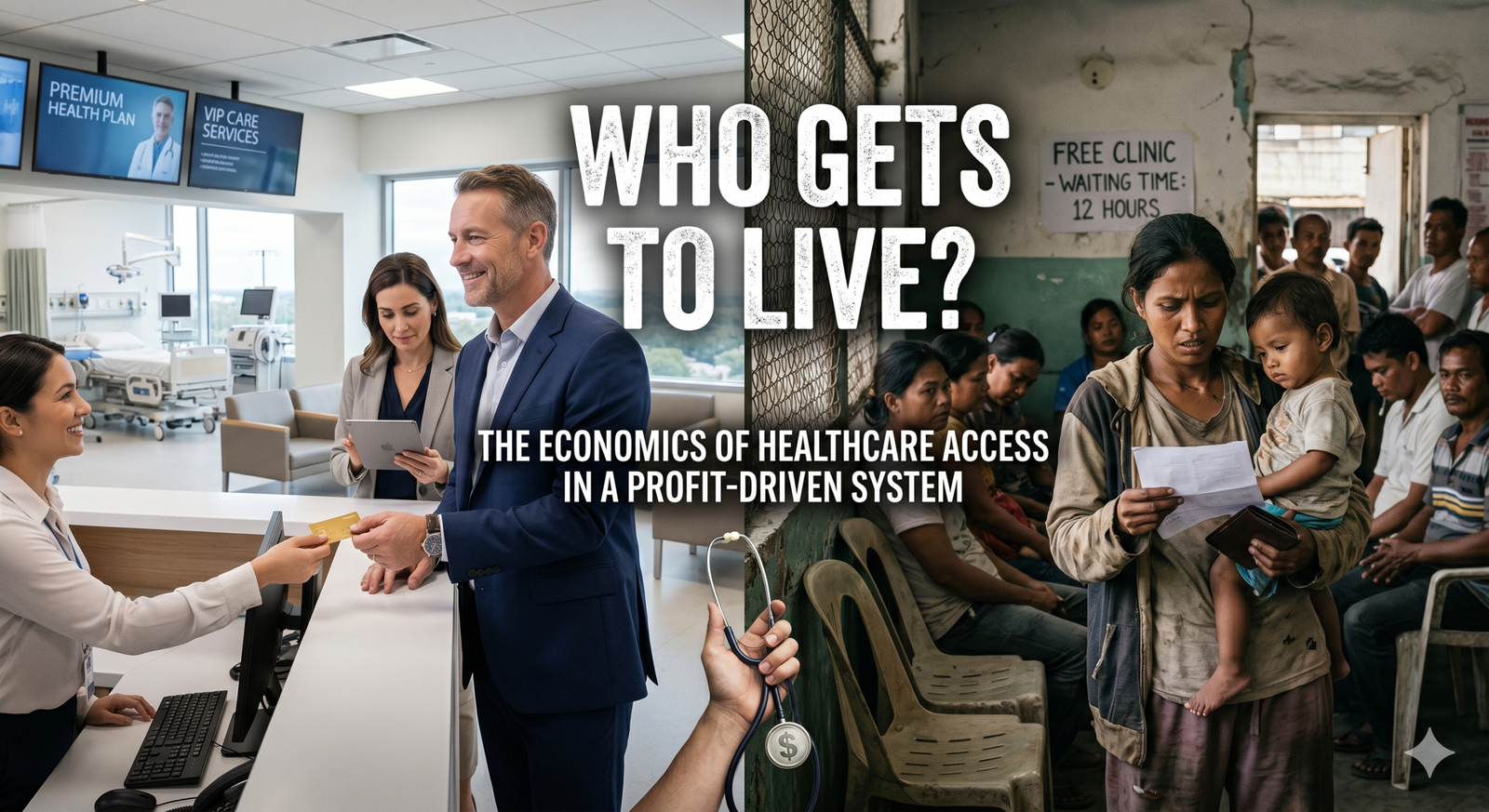

In the profit-driven healthcare industry, patients are often treated as ordinary consumers rather than individuals in need. This creates a fundamental ethical contradiction: can the invisible hand of the market truly manage a service where the stakes are life and death? When financial models begin to dictate the terms of care, the question of “who gets to live?” quietly transforms into “who can afford to?”
The American healthcare system is, by most measures, the most expensive in the world. This is not simply because medical care is inherently costly. It is the result of a complex administrative structure and deeply fragmented bargaining power. Unlike single-payer systems, where governments negotiate prices on behalf of entire populations, the American model relies on a sprawling network of private insurers, each operating with their own overhead, profit margins, and administrative costs. Every layer adds expense without adding care. Compounding this is the dominance of fee-for-service models, which reward the volume of procedures performed rather than the quality of outcomes. The result is a system that spends more and more while national health metrics continue to lag behind comparable countries.
Defenders of the market model argue that competition drives innovation, and there is something to this. The promise of high returns does attract venture capital into biotech and pharmaceuticals, and that investment has produced genuine breakthroughs, including advances in gene therapy and personalised medicine. But innovation without access is a limited kind of progress. When treatment decisions are filtered through utilisation reviews, where a claims adjuster can override a doctor’s recommendation in order to protect a profit margin, care effectively becomes a luxury good. People with lower incomes are frequently pushed toward reactive treatment in emergency rooms rather than the preventative care that would cost far less and serve them far better. The market produces breakthroughs that many of the people who need them most cannot afford to access.
Other systems offer a different starting point. The NHS in the United Kingdom operates on the principle that healthcare is a right rather than a product. By decoupling access to care from wealth and employment status, it achieves universal coverage at a fraction of the cost per capita. It has real limitations, particularly around wait times for elective procedures, and it faces ongoing funding pressures. But it does not produce medical bankruptcy. The ethical crisis at the centre of the American system, where a diagnosis can be financially catastrophic, simply does not exist in the same form.
What the economics of healthcare ultimately reveals is a question about priorities. A system that places shareholder returns above public wellbeing will, by design, produce a hierarchy of survival. That is not an accident or a flaw to be patched. It is the logical outcome of treating health as a commodity. Meaningful reform requires more than adjusting premiums or expanding coverage at the margins. It requires a shift in how healthcare is understood: not as a market to be competed in, but as shared infrastructure that a society either maintains for everyone or, in practice, denies to many.