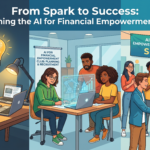


The ‘Digital Divide’ is no longer about who gets to scroll through social media; it is the line between those who can participate in the economy and those who are locked out of it. For an underprivileged student, the lack of a device isn’t just a missing gadget; it’s a missing bridge to the survival skills needed to build credit and escape poverty. Financial literacy isn’t a niche; it’s a requirement for the modern world. By denying a student a screen, we are effectively asking them to compete in a digital race while they are still stuck at the starting line. For millions, access to basic tech is the only way to make financial inclusion a reality.
In a time where the worldwide economy is etched in Artificial Intelligence, a student who does not attain a gadget is a student without a voice; it is unfair. This socioeconomic gap creates a limitless cycle where individuals with high-speed access leverage AI driven tools to grow their assets, whilst individuals without them are left to surf a composite financial landscape with no planned route. This is not a technological gap; it is a gap in opportunity. While one student employs an algorithm to optimize their future, another is blocked from starting a bank account. We are essentially allowing a lack of hardware to result in a permanent ceiling on what a person can achieve.
Turning ‘Waste Tech’ Into a Weapon For The Underprivileged
Trust me fellow investors, the solution is sitting in our junk drawers. Billions of perfectly functional devices are often discarded as e-waste. By redistributing these gadgets (United Nations Environment Programme), we can transform electronic garbage into a gateway for digital financial services.This provides underprivileged students the essential opening to truly understanding financial literacy.
Decoding The New Laws of Finance
Hardware supplies access, but financial literacy supplies power. With the use of a functional device; a student can access;
- Free stock market simulators (Investopedia) to practice real-time investing without the constant fear of losing legitimate equity. For an individual who has grown up viewing the stock market as a hobby for the wealthy, these simulators act as a risk free training ground, proving the claim that wealth building is a skill to be learned, not a secret only available to the wealthy.
- Direct tools such as M-Pesa(Vodafone’s mobile money software) and several blockchains that bypass digital obstacles. In theory, this looks like a student in a village receiving payment for freelance work or saving for tuition through a digital wallet, completely skipping the need for a brick and mortar bank that was never built in their town to begin with.
These resources demonstrate that once the wall of hardware is extinguished, these rules of finance alter from being exclusionary to being accessible to anyone with an internet connection.
From Passive Aid to Active Empowerment
The final goal of FinSmart is to move from ‘aid dependency’ to active empowerment by providing underprivileged students with the tools and knowledge to command their lives. We are not just giving a gift. We are giving these individuals the dignity to own their future. This shift alters the entire equation; a student is no longer a passive recipient of charity, but an active agent in the global economy.
By centering the aim of empowerment, every resource we provide – from refurbished hardware to M-Pesa accounts – serves as a step towards independence rather than just a temporary fix. When a student has the means to earn, save, and invest, they stop waiting for help and start building their own path.
Note
You are attempting to cover the digital divide, financial literacy, device redistribution, AI-driven inequality, and empowerment all in under four hundred words. Each of those ideas deserves breathing room. Right now the blog feels rushed, moving from one big claim to the next without stopping to develop any of them. Either focus the piece on one central argument and go deep, or expand each section so the claims are properly supported.